



PR CENTER
NEWSROOM
Distinguishing between one-way and two-way strip foundations
05-10-2026
Table of content
- 1. Distinguishing between one-way and two-way strip foundations
- 2. Why it is necessary to distinguish between one-way and two-way strip foundations
- 3. Advantages and disadvantages of one-way strip foundations
- 4. Advantages and disadvantages of two-way strip foundations
- 5. Should you choose one-way or two-way strip foundations
- 6. Notes when constructing one-way and two-way strip foundations
One-way and two-way strip foundations are two common types of shallow foundations widely used in residential and civil construction today. Each type has different characteristics, load-bearing capacity, and application scope. Through this article, BMB Steel helps you clearly understand the differences between one-way and two-way strip foundations, advantages and disadvantages, and important construction notes, thereby choosing the most suitable foundation solution for your project.
1. Distinguishing between one-way and two-way strip foundations
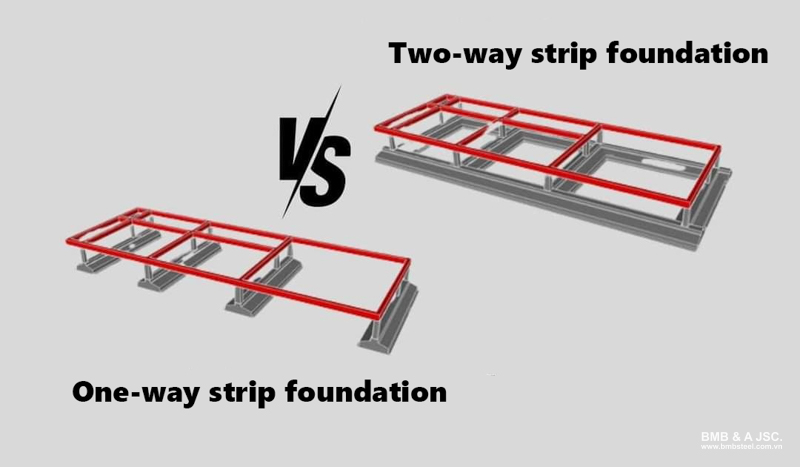
Strip foundation is a type of shallow foundation designed in long continuous strips, playing a key role in bearing loads and supporting the entire structural system of a building. Below is a comparison between one-way and two-way strip foundations.
1.1. Similarities
One-way and two-way strip foundations are both commonly used types of strip foundations in modern construction. Both belong to the group of shallow foundations and are usually embedded underground at a depth of about 1.5-2m. Their structure consists of long strips arranged along one direction or two directions of the building.
1.2. Differences
Differences in load-bearing direction:
- One-way strip foundations work and resist loads in only one direction, typically the shorter direction of the building. This type is suitable for structures with small widths and long lengths, or in cases where the soil has good bearing capacity.
- Two-way strip foundations can resist loads in both directions, including the short and long directions of the building. Therefore, two-way strip foundations are often applied to buildings with large widths and lengths, or when the soil condition is poor.
Differences in layout arrangement:
- One-way strip foundations are usually arranged in parallel strips, with spacing calculated based on foundation height, structural load, and soil bearing capacity.
- Two-way strip foundations are arranged in a grid system, with foundation strips running parallel in two perpendicular directions. The spacing between strips also depends on foundation height, applied loads, and soil bearing characteristics.
Other differences:
- Materials: One-way strip foundations generally require less material compared to two-way strip foundations.
- Cost: The construction cost of one-way strip foundations is usually lower.
- Size: One-way strip foundations typically have a smaller overall size than two-way strip foundations.
2. Why it is necessary to distinguish between one-way and two-way strip foundations
Distinguishing between one-way and two-way strip foundations is essential because each type has its own structural characteristics, load-bearing capacity, advantages, and disadvantages, making them suitable for specific construction conditions.
- For buildings with light to medium loads and relatively limited length, one-way strip foundations are often an appropriate choice. For example, a townhouse with a length of about 10m, a width of 5m, and light to medium loads can effectively use a one-way strip foundation.
- For structures with heavy loads and large overall dimensions, two-way strip foundations should be used to better meet load-bearing requirements. For instance, a high-rise building with a height of around 100m and significant loads typically requires a two-way strip foundation.
In addition, clearly distinguishing between one-way and two-way strip foundations helps engineers perform more accurate calculations and foundation designs, thereby ensuring technical accuracy and long-term safety for the structure.
3. Advantages and disadvantages of one-way strip foundations
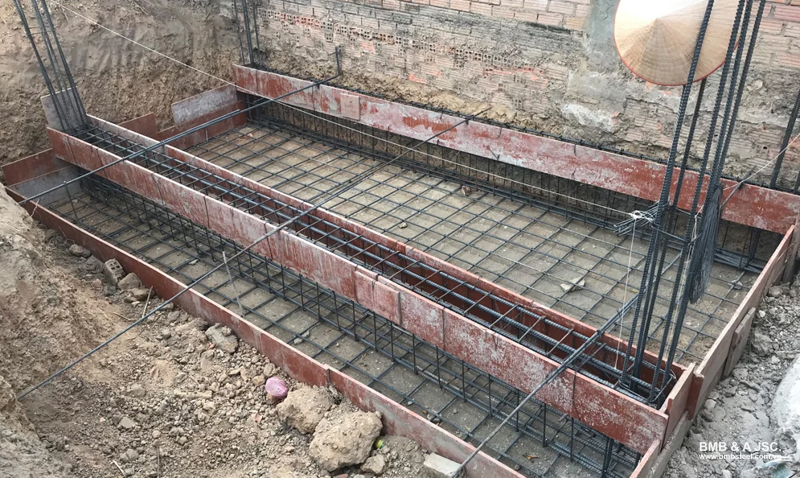
Advantages
- Simple construction: One-way strip foundations have a straightforward structure, and the construction process does not require highly complex techniques.
- Cost-effective: Due to the smaller quantity of materials and labor required, the construction cost of one-way strip foundations is usually lower.
- Adequate load-bearing capacity: This type of foundation can effectively support residential houses and townhouses with a scale of about 3 to 5 stories.
- Reduced risk of settlement and cracking: One-way strip foundations help distribute structural loads relatively evenly to the soil, thereby minimizing the risk of uneven settlement and cracking.
Disadvantages
- Limited load-bearing capacity: One-way strip foundations are not suitable for structures with heavy loads, such as high-rise buildings, factories, due to their load capacity limitations.
- Dependence on soil conditions: This type of foundation is only appropriate for soils with good bearing capacity. In cases of weak soil, ground improvement is required before construction.
- Susceptibility to water effects: One-way strip foundations require proper waterproofing measures, as water can negatively affect foundation performance.
4. Advantages and disadvantages of two-way strip foundations
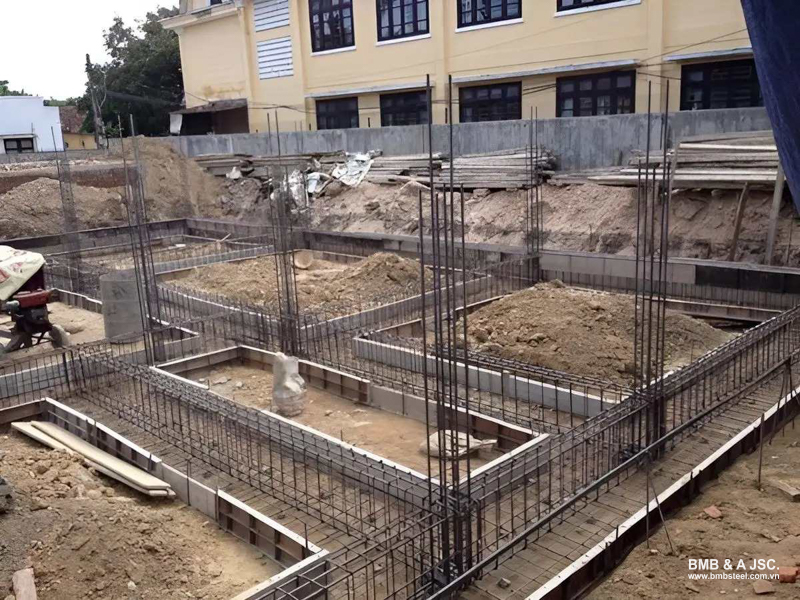
Advantages
- Enhanced structural connection: Two-way strip foundations connect columns and walls in the vertical direction into a unified structural system, thereby reducing differential settlement between columns and improving overall structural stability.
- Effective load distribution: With a larger contact area with the soil, two-way strip foundations transfer building loads more evenly to the ground, reducing concentrated pressure at the foundation base and enhancing structural performance.
- Suitable for various soil conditions: This type of foundation can be applied in areas with weak soil, clayey soil, or soil with groundwater, thereby expanding construction feasibility under challenging geotechnical conditions.
- Time- and cost-efficient compared to deep foundations: Compared with deep foundation solutions such as pile foundations, two-way strip foundations typically have lower construction costs and shorter construction time, helping optimize resources for project owners.
Disadvantages
- Load-bearing capacity dependent on soil conditions: On weak soil, the load-bearing capacity of two-way strip foundations is limited due to strong dependence on the bearing strength of the soil beneath the foundation base.
- Lower stability and sliding resistance: As a type of shallow foundation with limited embedment depth, two-way strip foundations generally have lower stability and sliding resistance compared to deep foundations such as pile foundations.
- More complex construction in deep groundwater conditions: When the soil has deep groundwater levels, constructing two-way strip foundations requires appropriate waterproofing and drainage measures, increasing construction complexity.
5. Should you choose one-way or two-way strip foundations
The decision to use one-way or two-way strip foundations should be carefully considered based on various technical factors, including the following:
- Structure size and shape: For buildings with a small width and a long length, one-way strip foundations are often a suitable solution. Structures with both large width and large length should prioritize two-way strip foundations to improve load distribution.
- Structural load: In cases where the building carries heavy loads, choosing two-way strip foundations will better meet load-bearing requirements.
- Soil bearing capacity: If the soil has good bearing capacity, one-way strip foundations can be effectively applied. However, when the soil is weak or unstable, two-way strip foundations are a more appropriate solution.
6. Notes when constructing one-way and two-way strip foundations
Setting out the foundation centerline

- The foundation centerline indicates the exact position where the foundation is placed on the construction layout.
- This process typically uses surveying equipment to accurately determine the coordinates and elevation of the centerline, followed by marking it directly on the ground with concrete stakes or bamboo stakes.
Excavating the foundation trench
- During excavation, the designed elevation must be strictly followed, avoiding excavation that is too deep or too shallow.
- The foundation trench must always be kept dry, and standing water should be prevented to avoid affecting foundation quality.
Reinforcement fabrication
- Reinforcement steel is the main load-bearing component of strip foundations.
- Reinforcement must be cleaned and free from rust before installation.
- Rebar joints must be welded or tied in accordance with technical specifications.
- Reinforcement must be supported at least 5cm above the bottom of the foundation trench.
Formwork installation
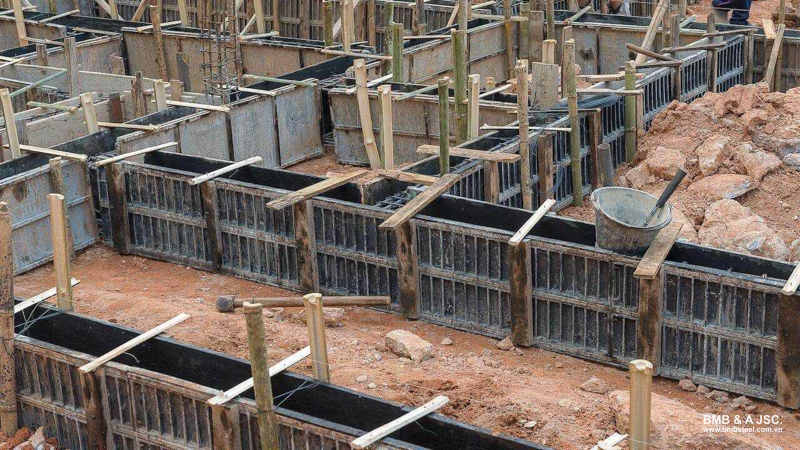
- Formwork is used to shape the foundation concrete.
- Before use, formwork must be cleaned and free from oil or grease.
- During installation, formwork must be securely fixed with supporting systems such as timber piles, beams, etc., to prevent movement during concrete casting.
Foundation concrete casting
- Concrete must be poured continuously without interruption.
- Concrete should be properly compacted to achieve the required density.
Concrete curing
- Concrete should be evenly watered for about 7 days after casting.
- The concrete surface should be covered with tarpaulin or plastic sheets to prevent rapid drying due to sunlight.
General notes
- The construction of one-way and two-way strip foundations must be closely supervised by qualified engineers to ensure construction quality and safety.
- All materials used for strip foundations must be quality-checked before use.
- Construction must strictly follow technical procedures.
Above are BMB Steel insights on how to distinguish one-way and two-way strip foundations, including their characteristics, advantages and disadvantages, and important notes during construction. Hopefully, this information will help you better understand strip foundations, thereby selecting an appropriate foundation solution that ensures safety and efficiency for the project.

2 years ago
Discover the growing demand for steel structures in global construction. Learn about steel structure types, advantages, and key applications.

5 months ago
An overview of commonly used heat-resistant roof materials, such as tiles, insulated metal roofing, etc., which are suitable for various types of buildings.

5 months ago
What is an EPC contract? Learn how EPC contracts work, contracting strategies, the role, pros, cons of EPC contractors and differences between EPC and EPCM.

9 months ago
What is a bolt? Learn about bolt structure, classification, applications, how to choose bolts that meet technical standards in construction and engineering.
9 months ago
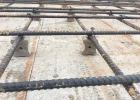
Detailed guidelines for proper single-layer slab reinforcement arrangement, important notes to ensure structural safety and extend the building’s lifespan.
Comment
(0)


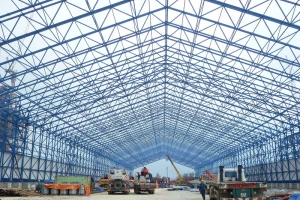
Using steel structures in construction works is gradually becoming prevalent by virtue of its benefits. However, using steel structure proficiently is very difficult. Hence, let's learn about the notes before the construction and erection of steel structures with BMB Steel.
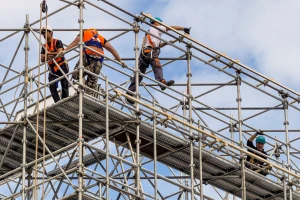
There are many essential pieces of equipment required for the steel erection process. The following writing shall provide detailed information about this.
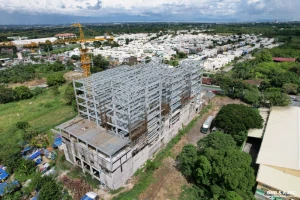
It is crucial to have a clear understanding of the differences between steel structure and reinforced concrete. This article will explore these differences.
Pre-engineered steel buildings are increasingly popular by virtue of their advantages, such as optimizing construction costs, short construction time, etc. Parallelly, owners are also concerned about some problems. In this article, BMB Steel will provide you with helpful information about construction standards and the acceptance of pre-engineered steel buildings.
Steel structures have been widely used in the construction industry. The writing below shall explore some applications of steel structures in the construction of sports and entertainment facilities.
Sustainability has been a trend and priority in the construction industry. This writing will explore some sustainability certifications that are relevant for steel structures.

