



PR CENTER
NEWSROOM
Standards for strip foundation drawings for a two-story house
05-10-2026
Table of content
Strip foundation drawing for a two-story house is an important technical document that clearly reflects the structure, dimensions, and construction requirements of the foundation system. Through this article, BMB Steel provides more detailed information on strip foundation drawings for a two-story house, related technical standards, construction procedures, and necessary considerations to ensure the foundation work is carried out correctly and with high accuracy.
1. Strip foundation drawing for a two-story house
Compared to the foundation of a one-story house, constructing a strip foundation for a two-story house requires higher technical accuracy and must be carried out with greater care and precision.
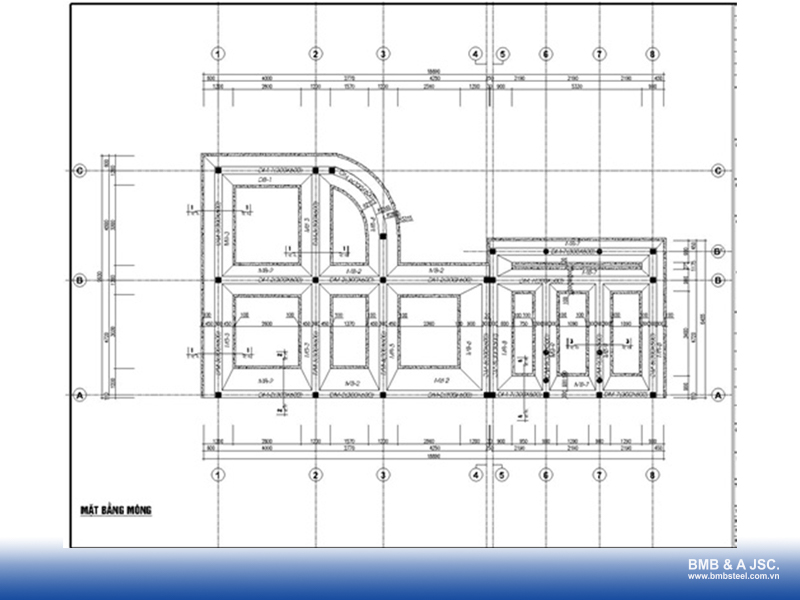
The strip foundation for a two-story house consists of a concrete layer, foundation slab, foundation beams, reinforcement steel, along with other related structural components. These elements are tightly connected to form a stable foundation system, ensuring proper construction sequence and technical compliance.
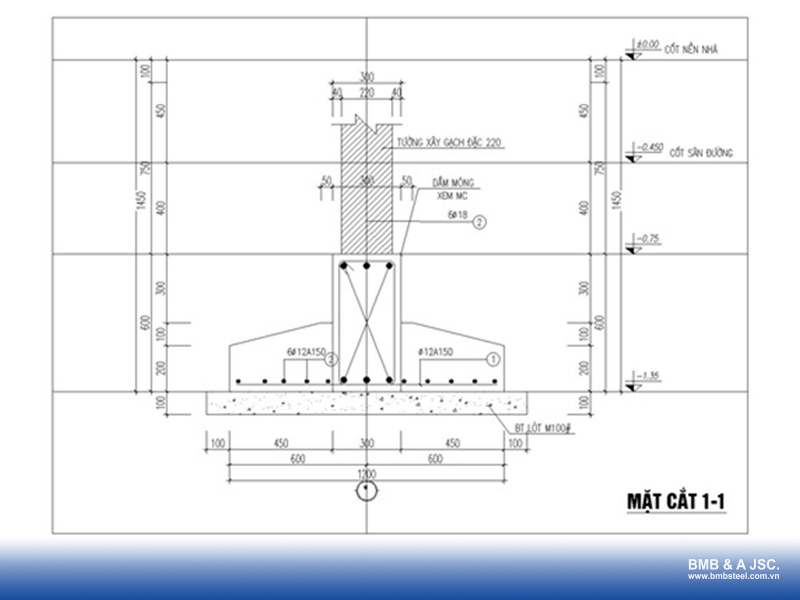
Below is a reference drawing for the construction of a strip foundation for a two-story house:
2. Standards for strip foundation drawings for a two-story house
A strip foundation for a two-story house is a type of foundation with a length significantly greater than its width, commonly arranged beneath walls or columns to enhance the load-bearing capacity of the structure.
Depending on specific technical requirements and design solutions, architects apply different calculation methods for strip foundations based on relevant standards.
2.1. Dimensions of strip foundation drawings for a two-story house
To ensure durability and safety during operation, dimensional parameters shown in strip foundation drawings for a two-story house play a crucial role. Specifically:
- Foundation beam dimensions: Foundation beams typically have a width of about 300 mm and a height ranging from 500-700 mm. These dimensions are often determined using the principle of approximately 1/10 of the largest span length of the building to ensure adequate bending capacity.
- Reinforcement structure of foundation beams: Longitudinal reinforcement commonly consists of 6 bars with diameters ranging from Φ18 to Φ22. Stirrups usually use Φ8 steel, arranged at 150 mm spacing, denoted as Φ8a150.
- Foundation slab reinforcement: The foundation slab generally has a width of 900-1200 mm and a height of around 350 mm. It is typically reinforced with Φ12a150 steel to distribute loads from the foundation beams over a larger soil area, helping reduce cracking and minimize the risk of uneven settlement.
2.2. Spacing of columns, beams, foundations, and stirrups
Determining the spacing of columns, beams, foundations, and stirrups in strip foundation drawings for a two-story house must be calculated based on the clear span of the building. These parameters must meet technical requirements, ensuring they are not smaller than the reinforcement diameter and do not exceed the maximum limits specified by standards.
Reinforcement arrangement should comply with the following principles:
- The embedment depth of the foundation usually ranges from 1.2-1.5 m, measured from ground level to the foundation bottom, applicable to stable and good soil conditions.
- The spacing between bottom reinforcement layers is 25 mm.
- The spacing between top reinforcement layers is 30 mm.
- If reinforcement is arranged in two layers, the spacing between the two upper layers should be 50 mm.
- Owners may choose M250-grade concrete for the main foundation to ensure load-bearing capacity, and M100-grade concrete for the blinding layer to create a clean working surface.
- When using a poker vibrator during construction, the top clearance must be sufficient to allow proper insertion of the vibrator.
- The spacing between floor beams and frame beams should be arranged to ensure a right angle.
2.3. Technical specifications of materials
In addition to dimensional and structural requirements, standards for material technical specifications used in strip foundations for a two-story house are also important. Accordingly, construction must meet the following requirements:
- For reinforcement steel used in strip foundation construction, any reduction in cross-sectional area during cleaning or transportation must not exceed the allowable limit. The maximum allowable reduction is specified as 2% of the steel diameter.
- Reinforcement must be firmly fixed before construction using spacers or concrete cover blocks. The spacing of these supports should follow appropriate ratios to minimize displacement during construction.
- Formwork for concrete casting must meet requirements for thickness and load-bearing capacity and must not deform under the weight of concrete.
- Concrete must be mixed in correct proportions, kept clean, and free from impurities to ensure the quality and durability of the foundation.
2.4. Principles for determining the depth of a strip foundation for a two-story house
The depth of a strip foundation for a two-story house directly affects the stability of the structure. If the foundation is not embedded deeply enough, the building may experience uneven settlement, wall cracking, or structural deformation during use.
Determining the foundation depth should follow these principles:
- Based on soil conditions: The foundation depth must ensure that the foundation bottom is fully placed on a good soil layer with stable structure and high load-bearing capacity. Foundations should not be constructed on weak soils such as mud or newly filled soil that has not been properly compacted, as these soils are prone to settlement and deformation over time, affecting structural safety.
- Based on building height and load: The larger and heavier the building, the greater the load transferred to the foundation, requiring deeper embedment to distribute forces evenly to lower soil layers. According to practical design experience, the foundation depth (H) should be greater than or equal to 1/15 of the total building height.
- Special design cases: For buildings with basements or semi-basements, calculating foundation depth becomes more complex and requires experienced architects. In such cases, the foundation must withstand not only vertical loads but also lateral earth pressure, functioning as part of the basement wall structure.
3. Construction process of a strip foundation for a two-story house
The construction process of a strip foundation for a two-story house requires high accuracy and must strictly follow the design drawings. The entire process includes the following steps:
3.1. Geotechnical survey and site preparation
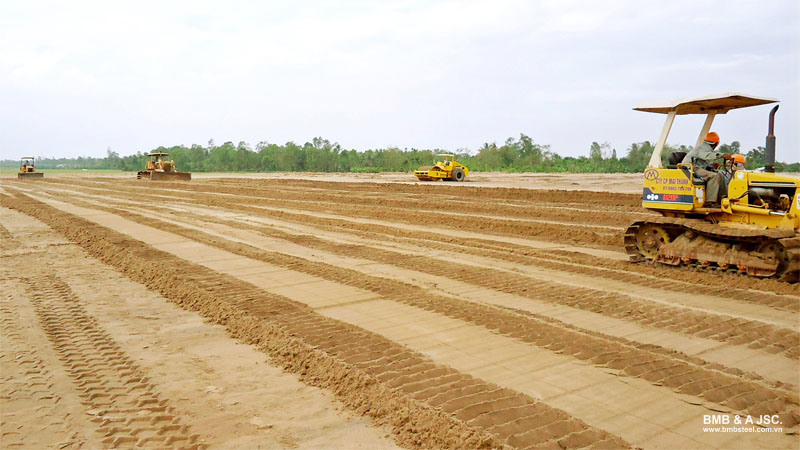
A geotechnical survey is carried out to recheck soil conditions, thereby determining whether the strip foundation is suitable for actual site conditions.
At the same time, the construction area is cleared by removing trees, waste, and existing structures to ensure a safe working environment. After that, based on the design drawings, engineers use specialized equipment to accurately determine the foundation centerlines and column axes.
3.2. Excavation of foundation trenches and placement of blinding concrete
Foundation trench excavation is carried out either mechanically or manually according to the exact dimensions, shape, and depth shown in the drawings. The trench bottom is leveled and compacted to create a stable base.
Next, a blinding concrete layer with a thickness of approximately 100mm is poured to create a clean working surface, facilitate reinforcement fabrication, and prevent the main foundation concrete from losing cement water into the soil, thereby helping the foundation achieve better strength.
3.3. Reinforcement fabrication and installation
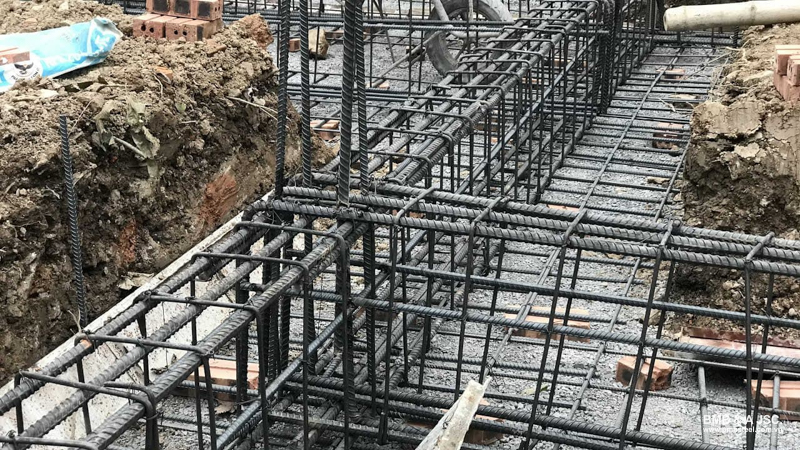
At this stage, reinforcement is fabricated by cutting and bending according to the required technical specifications. The steel used must meet standards for strength and ductility, have a clean surface free from rust, and comply with the designed dimensions.
Steel joints must also comply with technical requirements, in which welded joints must be equal to or greater than 10 times the diameter of the steel bar, while tied joints must reach at least 30 times the bar diameter to ensure proper connectivity.
3.4. Formwork installation and concrete pouring
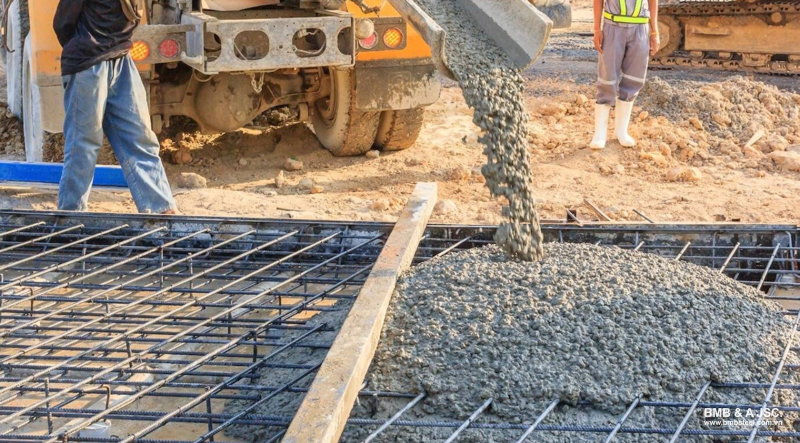
The contractor installs formwork to shape the foundation and foundation beams. The formwork must be firmly and tightly assembled to prevent leakage or deformation during concrete pouring.
After completing the inspection and acceptance of reinforcement and formwork, concrete is poured continuously and compacted using a vibrator to remove air voids, helping the foundation achieve a dense and uniform structure.
3.5. Curing and completion
After concrete pouring, continuous water curing must be carried out for at least the first 7 days to help the concrete reach its maximum strength and minimize cracking caused by rapid drying. Once the concrete has gained sufficient hardness, usually after about 24-48 hours, the formwork can be removed, and construction can proceed to the next stages.
4. Notes on designing and constructing a strip foundation for a two-story house
The durability and stability of a house largely depend on the quality of its foundation. Therefore, during the design and construction of a strip foundation for a two-story house, the following important issues should be carefully considered:
4.1. Reinforcement for weak soil conditions
For areas with weak soil such as soft clay, mud, flowing sand, etc., the ground must be treated before constructing the strip foundation to minimize the risk of settlement, cracking, or structural instability. Some commonly applied solutions include:
- Reinforcement using melaleuca/eucalyptus piles: This method is suitable for waterlogged areas. Melaleuca piles are driven to a depth of approximately 2.5-3.5m with a standard density of about 25 piles/m², penetrating through the weak soil layer and anchoring into a stronger soil layer below. Pile driving is typically carried out using vibratory hammers or manual drivers, following a spiral sequence from the outside toward the center to ensure vertical alignment.
- Sand or crushed stone bedding: Applied when the weak soil layer is less than 3m thick. The weak soil is completely excavated and replaced with sand or crushed stone with better load-bearing capacity. The material is placed in layers 20-30cm thick and compacted by machine until the required compaction level is achieved, commonly indicated as K ≥ 0.9.
- Widening the foundation footing: Increasing the contact area between the foundation and the ground helps reduce the pressure transmitted to the soil. For example, the footing width can be expanded from 1.0m to approximately 1.2-1.4m, depending on the engineer’s calculations based on the bearing capacity of the treated soil.
- Enhancing the overall stiffness of the foundation system: This can be achieved by increasing the height of foundation beams, adding more longitudinal reinforcement, or installing additional tie beams so that the foundation system works more uniformly and becomes more stable.
4.2. Selection of quality materials
Currently, there are many types of construction materials available on the market. For residential buildings, materials that meet quality standards should always be prioritized. However, homeowners should also consider and select materials that are appropriate for the actual conditions and requirements of the project.
4.3. Compliance with design and selection of a reputable contractor
During construction, the workforce must strictly follow the approved design drawings and established construction regulations. Proper compliance helps minimize risks such as foundation settlement, floor cracking, or structural damage.
Therefore, choosing a professional and experienced contractor is extremely important, especially for projects with high technical requirements. It is advisable to avoid assigning critical construction tasks to teams that lack sufficient experience or formal training.
The strip foundation drawing for a two-story house plays a pivotal role throughout the construction process. All aspects must be carried out strictly in accordance with the drawings, including dimension determination, reinforcement arrangement, material selection, construction procedures, and technical considerations. Full compliance with these requirements helps ensure that the foundation remains strong, safe, and stable throughout the building’s service life.
Through this article, BMB Steel hopes that you have gained a comprehensive understanding of strip foundations for two-story houses, enabling you to more easily evaluate and choose suitable solutions for your construction project.

2 years ago
Explore factory design processes with BMB Steel. Discover 2026 pricing for factory design and construction services, optimized for space, cost, and ensure high-quality construction.

6 months ago
What are shop drawings? Learn about the roles, categories, design process, and requirements for engineers when implementing shop drawings in construction.

6 months ago
What factory construction permit costs in 2026 are included, how much to budget, processing time, and which authority issues the permit? Find out here.

9 months ago
What are reinforced concrete roofs? Learn about their structure, pros and cons, types, applications in construction, and key notes for proper installation.

10 months ago
Learn about 4 types of metal roof ventilation, why it matters, and proper installation methods to improve energy efficiency and extend your roof’s lifespan.
Comment
(0)


Selecting the right steel material is crucial for pre-engineered steel buildings. This article shall discuss key factors to consider when choosing steel materials for pre-engineered steel buildings.
What are reinforced concrete roofs? Learn about their structure, pros and cons, types, applications in construction, and key notes for proper installation.
Are you looking for a small industrial factory design drawing? Do you need information about the advantages or disadvantages? The following article will help you with the above problems.
What are shop drawings? Learn about the roles, categories, design process, and requirements for engineers when implementing shop drawings in construction.

This article is going to provide you with the list of the most major construction companies in Vietnam in 2026 for your reference. Let's look at this article to find out your choice of a construction corporation.
Small pre-engineered factories are gradually becoming prevalent by virtue of their cost-effectiveness. With a variety of designs and gorgeous structures, which factory model will you choose?

